
The Best Way to Optimize Multiple Card Purchases on eBay: Cheapest Total vs. Fewest Sellers
If you're buying more than a card or two, the best way to optimize multiple card purchases on eBay isn't to chase the lowest price on each one, tab by tab. It's to treat your whole want-list as a single order and pick a buying strategy up front. There are really only two that matter: the cheapest total across every seller, and the fewest reliable sellers. This guide covers when each one wins, and how to stop doing the math by hand.
Both tactics start from the same insight: on a marketplace with thousands of independent sellers, the lowest sticker price on a card is not the same as the lowest cost to get your whole list to your door. (If that idea is new, the deeper case is in how to stop overpaying for shipping by consolidating orders.) Once you accept that, buying a list becomes a choice between two goals.
The two questions every want-list buyer is really asking
When you sit down with a list of ten, thirty, or a hundred cards, you're optimizing for one of two things, whether you've named it or not:
- "What's the least I can possibly pay?" You want the rock-bottom total, cards plus all shipping, and you don't mind buying from a few more sellers to get there.
- "How do I keep this simple and safe?" You'd happily pay a couple dollars more to deal with two or three trusted sellers instead of eight, so there are fewer packages to track and fewer strangers to vet.
Neither is the "right" answer. They're two different jobs, and the best tactic is the one that matches the job in front of you.
Tactic 1: Cheapest total (shop the whole list at once)
This is the strategy for squeezing out the lowest possible number. The key move is that "cheapest" is measured on the whole order, not card by card.
Here's why that distinction matters. Say Seller A has the single cheapest copy of one card on your list, $0.50 under everyone else. Buying it there is only a saving if it doesn't add a fresh shipping fee to your order. If Seller B already carries five other cards you need, adding that one card to B's order, even at $0.50 more, beats opening a whole new order with A and paying another $2 to ship it.
The rule of thumb: a card is only cheaper somewhere else if the saving survives the extra per-seller shipping fee that a new seller adds to your order. The true cheapest total almost always comes from concentrating your list across a handful of sellers, not from collecting the lowest sticker price on every card.
Done properly, the cheapest-total tactic prices every card against every seller who has it, adds each seller's shipping, and then searches across the combinations for the mix that minimizes the grand total. It may split your list across four or five sellers, but the number at the bottom is as low as it goes.
Tactic 2: Fewest reliable sellers (buy coverage, not just price)
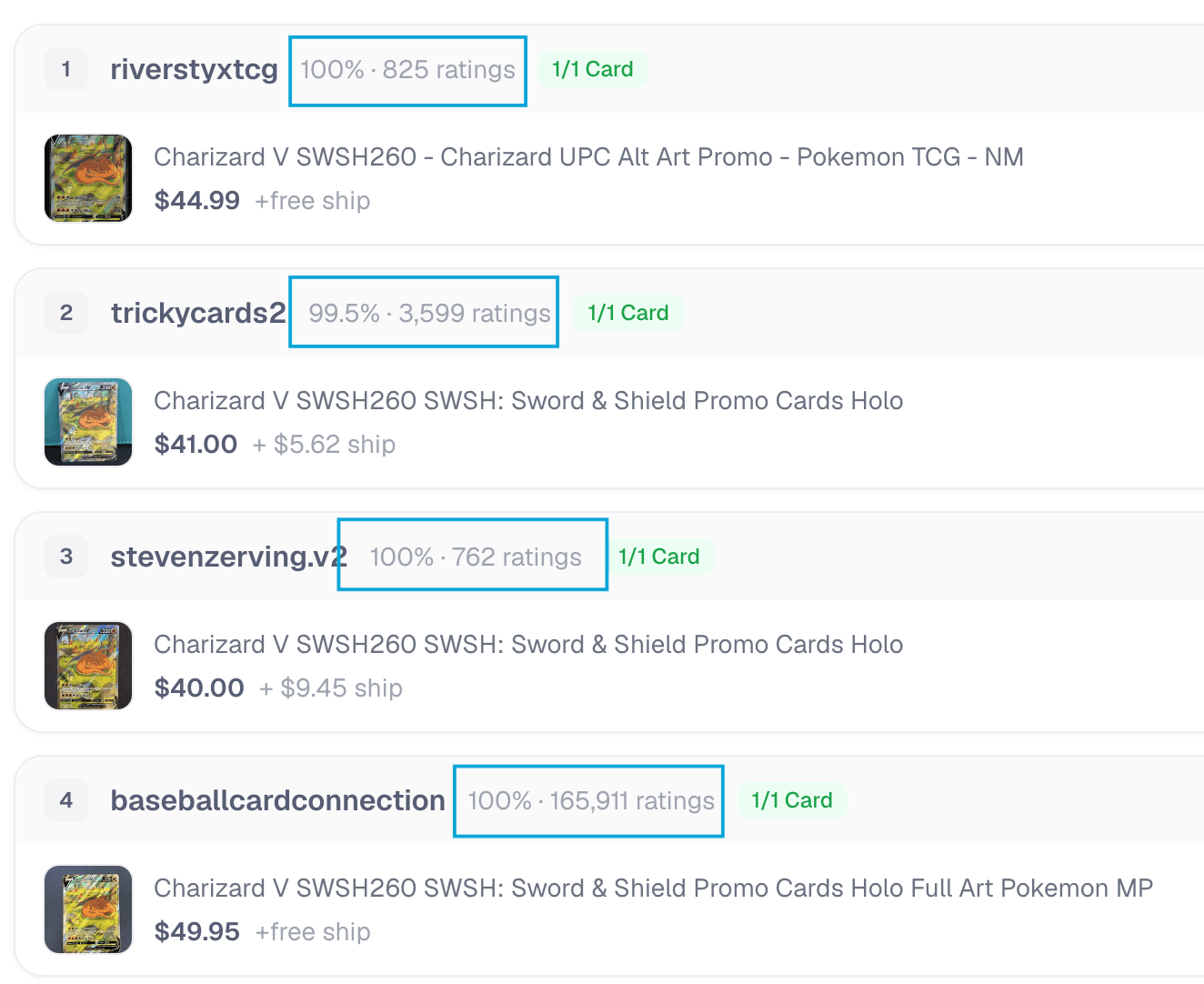
Sometimes the last dollar isn't the point. If you're buying thirty cards, the difference between five orders and two is real: fewer tracking numbers, fewer sellers to check the feedback on, fewer chances for one package to arrive damaged, misgraded, or not at all.
The fewest-sellers tactic optimizes for coverage: which small set of well-rated sellers can fill as much of your list as possible? You accept that you might pay a little more than the absolute floor, in exchange for a simpler, lower-risk checkout. It's the right call when:
- Your list is long enough that managing many orders is a chore.
- You care more about seller reputation than shaving the last few dollars (graded slabs, pricier chase cards).
- You want everything to arrive in as few packages as possible.
Which one should you pick?
Use this as a quick gut check:
| If you want to... | Pick |
|---|---|
| Pay the lowest possible total, cards + shipping | Cheapest total |
| Deal with as few reputable sellers as possible | Fewest sellers |
| Buy cheap bulk / commons where risk is low | Cheapest total |
| Buy pricey, graded, or chase cards you want vetted | Fewest sellers |
| Get everything in one or two packages | Fewest sellers |
In practice the two plans often land close together, because the cheapest total already tends to cluster your list across a few sellers. The gap is usually a couple of dollars, so the honest question is whether that couple of dollars is worth one or two extra orders to you today.
Let the plans do the math
The logic is simple; the arithmetic is brutal by hand. To actually find the cheapest total you'd have to price every card against every seller, add each seller's shipping, and search across all the combinations, and that's before you factor in seller reputation. No stack of open tabs and a spreadsheet solves it well once your list runs past a dozen cards.
This is exactly what Capyberry was built for. Paste your whole want-list and it searches every card across eBay at once, groups the results by seller, and hands you both plans ready-made: Price for the cheapest total, and Coverage for the fewest reliable sellers, each with the real number, cards plus shipping, so you can pick the tactic and check out.
For the broader playbook, buying safely, reading listings, and vetting sellers, start with the complete guide to buying Pokémon cards on eBay safely. The best way to buy a whole list, though, comes down to this one decision: are you optimizing for the last dollar, or for the simplest, safest checkout? Name the goal, pick the plan, and let the totals decide where each card comes from.
Ready to shop smarter? Paste your want-list and let Capyberry find the best way to buy your whole list.